
What numbers are actually useful for your business?
Most business owners know they should be across their numbers; the problem isn't awareness, it's that most are either tracking too many, or checking them too late to do anything useful with what they find.
We've worked with businesses running dozens of KPIs every month who still feel like they're flying blind. We've also worked with businesses that review just five numbers every week and make faster, better decisions because of it.
The difference isn't the spreadsheet. It's knowing which numbers actually matter.
At Juno, we believe numbers should create conversations, not confusion. Here are the five every business owner should have on their radar.
1. Revenue
Are we bringing enough work into the business?
Revenue is the easiest number to understand and one of the easiest to misread. A strong month doesn't automatically mean a healthy business. Tracking revenue consistently is what helps you understand whether you're building momentum, or quietly starting to lose it.
Each week, it's worth asking: are sales trending where we expected? Are we ahead or behind the target? Is revenue consistent, or starting to become unpredictable? Which parts of the business are actually growing?
Revenue tells you what's happening. The other four numbers tell you whether it's sustainable.
2. Margin
Revenue without margin is growth without profit.
One of the most common mistakes we see is businesses celebrating record sales while making less money than ever before. More work isn't always better work. Healthy businesses know exactly where they're making money and where they're quietly giving it away.
Weekly margin reviews should cover gross margin, profit by product or service, pricing performance and labour or delivery costs.
A small improvement in margin often has a bigger impact on the bottom line than a significant increase in sales. The question to sit with isn't just "how much did we sell?", it's "was it worth selling?"
3. Cashflow
Profit looks great on paper. Cash pays wages.
Cashflow is what keeps businesses alive, and it deserves a weekly conversation rather than just a line item in a monthly finance meeting. We've seen profitable businesses fail because they ran out of cash. It happens more than people realise, and it's almost always avoidable with enough visibility.
The numbers worth watching weekly: current cash position, outstanding debtors, upcoming payments, cashflow forecasts and working capital.
Knowing what's coming gives you options. By the time a cash problem becomes obvious, the window to act on it has often already closed.
4. Pipeline
Revenue tells you where you've been. Pipeline tells you where you're going.
Inconsistent sales momentum is one of the most common sources of stress for business owners. Busy one month, quiet the next, then scrambling to fill the gap. A healthy pipeline creates confidence, and early warning when things are slowing down.
Weekly pipeline reviews should cover the number of active opportunities, the value of future work, conversion rates, lead quality and sales activity.
The goal isn't simply to have opportunities in the pipeline. It's to have enough of the right opportunities.
5. Team Capacity
Can the business actually deliver what's being sold?
This is the number most businesses ignore until it's too late. Growth is exciting, but growth without capacity leads to burnout, missed deadlines, declining quality and frustrated clients. We've seen businesses chase every opportunity, then wonder why their team, culture and client experience started to suffer.
Each week, it's worth asking: do we have the people to deliver what's been committed to? Where are the bottlenecks? Is anyone carrying too much? Do we need to hire, reprioritise, or say no to something?
Capacity planning isn't about limiting growth. It's about making sure growth is actually sustainable when it arrives.
The Real Number That Matters for Your Business
These five numbers aren't powerful in isolation. What's powerful is building a consistent rhythm around them.
One client introduced a simple weekly leadership review focused on these core metrics. Within 60 days, decision-making had sped up significantly. Issues were being caught before they became expensive. Leaders were calmer because everyone had a shared, accurate picture of where the business stood.
The numbers themselves didn't change anything. The conversations did.
Businesses that improve fastest don't always have the most sophisticated dashboards. They simply have better conversations, more regularly, about what the numbers are actually telling them.
From Visibility to Momentum
At Juno, we think most businesses don't need to be more complicated. They need to be more visible! When leaders genuinely know their numbers, decisions get sharper, problems get solved earlier, and the business moves with confidence rather than instinct and guesswork.
Visibility creates accountability. Accountability drives execution. Execution creates momentum. That's where real growth happens. Not in the dashboard, but in what you do with what it shows you.
Where to Start With Your Business’ Numbers
Every business could track 50 different metrics. Very few need to.
Start with five. Review them every week. Talk about what they mean, not just what they are. The businesses that consistently win aren't the ones with the most impressive reporting. They're the ones that turn insight into action, week after week.
The Numbers Cheat Sheet
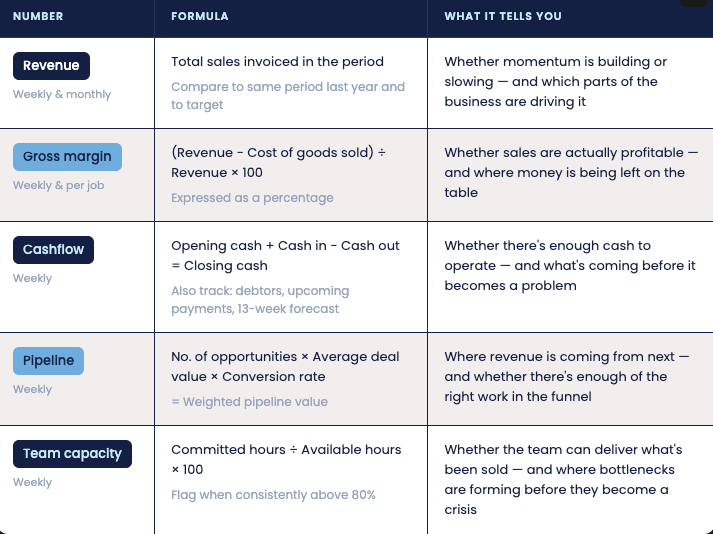
Not sure which numbers matter most for your business right now? That's exactly the kind of question we work through in an Unpack session. Get in touch.
